Chris Basmajian / /
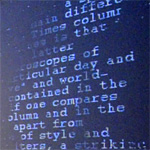
2011
Interactive Video
This 2-sided projection piece combines Theodor Adorno's mid-fifties analysis of popular astrology with a running archive of the Daily Horoscope from Astrology.com.
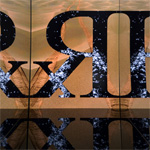
2011
Interactive Video
Based on the concept of retrograde, the illusion of a planet looping backward and forward through the night sky.
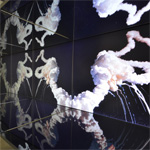
2011
Interactive Video
A mirrored box reflects an image of the Space Shuttle Challenger explosion that scrambles and unscrambles in response to the viewer's motion.
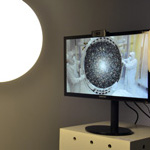
2011
Interactive Video
Based on the NASA Kepler mission, the goal of which is to detect earth-like planets and gauge how common they are on a universal scale.
2010
Custom Software
This piece is a simple text-based generative video commenting on the reaction to the Deepwater Horizon Oil Spill in the Gulf of Mexico.

2009
Single-channel Video
Produced in collaboration with Christian L. Frock and Invisible Venue
This piece is a site-specific video projection created for the 20th anniversary of the Loma Prieta earthquake in Oakland, California.
2009
Interactive Video
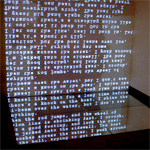
In this piece the viewer moves in front of a video camera and looks down into mirrors on the floor to read a story by Scott Hutchins about a fisherman hunting a nun-eating shark.
2009
Interactive Video
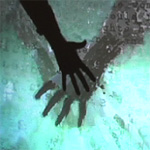
In this piece, viewers connect with a tale of international kidnapping by Adam Johnson, as they disturb text and image by moving in front of 2 cameras, or on the far side of a rear projection screen.
2008
Interactive Video
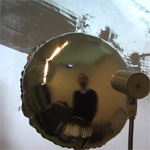
A festive reflective balloon is placed between a video camera and a projection which combines the video with a photograph of the Hindenburg disaster.
2008
Interactive Video
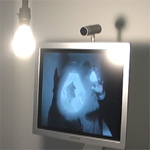
A hanging light bulb links the viewer to a scene from Godard's Alphaville.
2008
Interactive Video
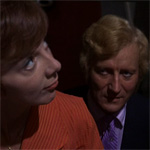
This piece uses the proximity of the viewer to create evocative temporal distortions in a famous tracking shot from Hitchcock's Frenzy.
2008
Interactive Video
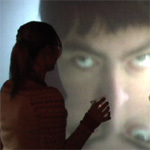
This piece captures video of the viewer, then temporally and spatially inverts the video in a cycling display.

2008
Video Game/Widget
Wallow in your own wasted time.

False Binaries (Black & White) (Series)
2008
Interactive Video
The works in this series capture live video of the viewer, and translate each grayscale pixel's binary representation (electronic data) into a black or white representation (visual) to create a binary (1-bit) image.

False Binaries (Rhetoric) (Series)
2008
Interactive Video
This series uses words from some familiar phrases and expressions to define the borders between moving images of the viewer.

Mathemes (Series)
2008
Interactive Video
This series uses Lacan's notational symbols to define the borders between moving images of the viewer.

Graphemes (Series)
2007
Interactive Video
This series uses letters, punctuation marks, mathematical operators and musical symbols to define the borders between moving images of the viewer.
Unspooled (Series)
2007
Interactive Video
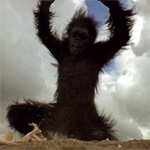
This series temporally reinterprets iconic moments in popular cinema.
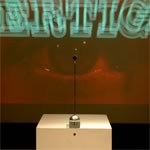
Looking Back (Series)
2006
Interactive Video
This series explores the films of Alfred Hitchcock and the writings of Jacques Lacan and Slavoj Zizek.
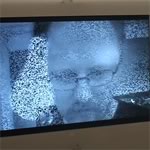
2006
Interactive Video
This piece combines the image of the viewer with the light bulb scene from the end of Hitchcock’s Psycho.
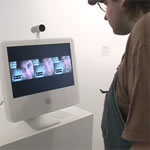
2006
Interactive Video
Each of these panoramas displays three horizontally oriented views of the viewer’s motion, played forwards, backwards, and in combination.
2006
Interactive Video
The captured motions of viewers are algorithmically manipulated in various ways and projected onto a large screen.
